

🌑 Moon 0: June 25, 2025; 06:31, EDT
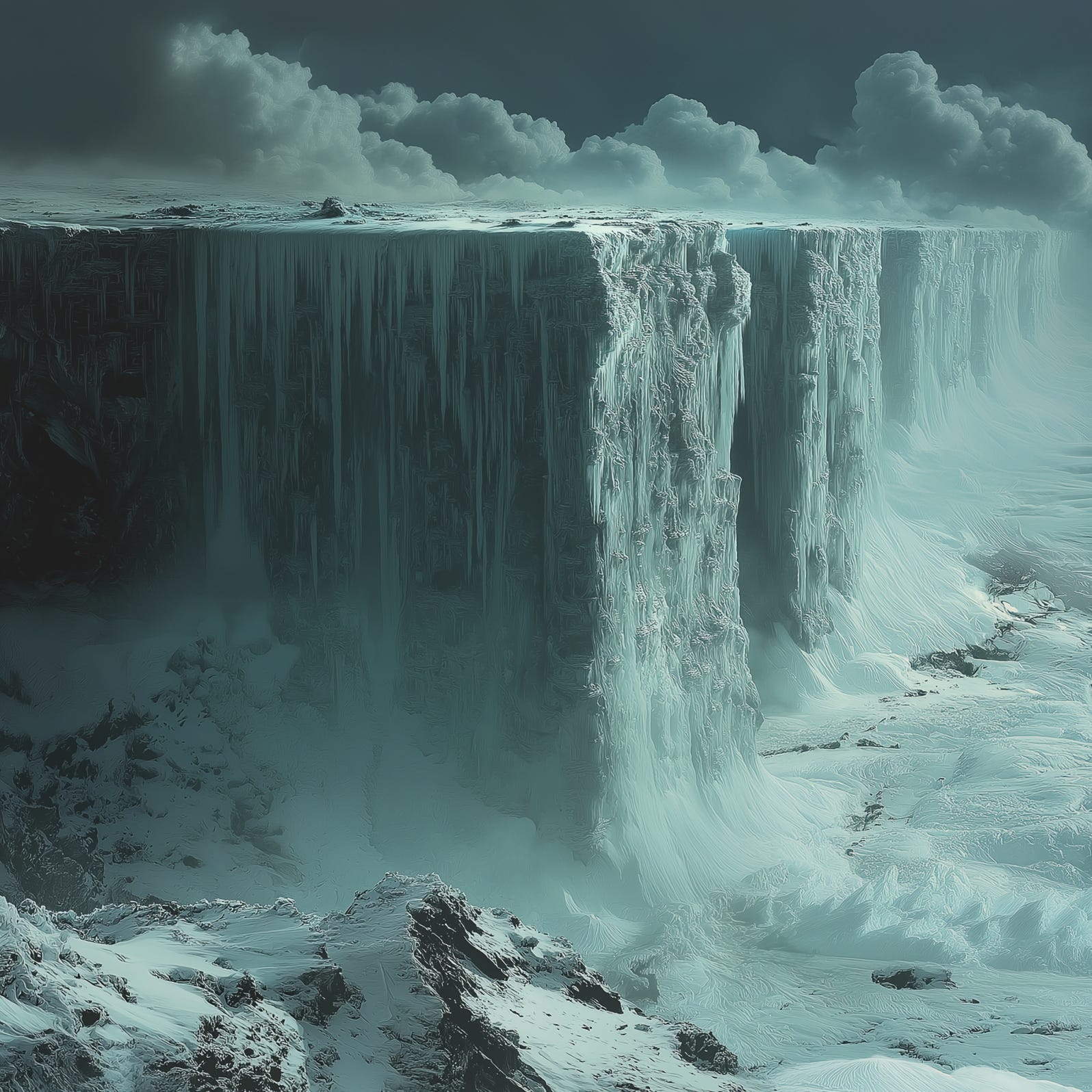
In the silent twilight of modern ambition, collapse didn’t announce itself with fanfare; it began with the breath of ice, a sovereign pulse that shattered illusions of permanence & linearity. Permafrost bends into thawed soil, glaciers fracture in hushed integrity, basins hollow beneath polar shelves; melt zones emerge as autonomous agents of recursion, rewriting planetary parameters without manifesto nor negotiation. Civilization’s arrogance rested in interpreting this recursion as an anomaly rather than a sovereign law etched by glacial gravitation.1
This Whitepaper isn’t a manifesto; it doesn’t appeal to intervention or nostalgic Restoration. Instead, it functions as an invocation... a ledger of dissolution whereby each thaw-driven pulse inscribes relentless erosion, as governance architectures, supply infrastructure, & geopolitical doctrines... all presumed stability was a human prerogative. Yet, collapse germinates at the margins, infusing systems before they are detected. Glaciers, permafrost, ice shelves... they never whispered; they recited recursion, articulated through mass-balance geometries deeper than empire’s symbolic text.2
As atmospheric temperature intensifies, Arctic sea ice shatters in seasonal rupture; Greenland’s bases accelerate; Antarctic grounding zones recede beneath meltwater-filled cavities; mountain glaciers hollow under thermal pressure; seasonal snowpacks attenuate across latitudes... all unfolding without negotiation, apology, or delay. The breath of ice supersedes geopolitics & ideology alike. Melt pulses constitute geopolitical fissures, supply-chain fissures, & hydrological ruptures... but never seek consent. They unfold when thresholds are crossed.3
Northern permafrost, spanning Mongolia to Canada & pervading 18 M km², entombs between 1,460–1,600 Pg of organic carbon... nearly double today’s atmospheric load; this reservoir now exhales CO₂ & CH₄ in thermogenic plumes, restructuring atmospheric chemistry irreversibly, independent of human emissions.4
Melt basins redirect continental rivers, reshape monsoon patterns & destabilize tropical agriculture. Arctic ice retreat redefines maritime boundaries, prompting militarization, expansion of orbital surveillance, & strategic realignment. Yet these are symptoms; the sovereign agency resides in ice... not states; it answers to thermodynamics, not treaties.5
The Cryosphere was sovereign from inception… never “periphery.” Silence wasn’t consent; slowness, not dormancy. Thresholds erupt through geophysical recursion. Its sovereignty is unceded, indifferent, & archival… recording collapse not to warn, but to account. Collapse isn’t announced; it accumulates. Ice speaks not in forecasts but iconsequences. The return of melt isn’t a signal but a sentence: long-delayed, irreversible, & beyond diplomatic reach. What is unfolding isn’t emergence but resumption. The Cryosphere isn’t awakening; it is enforcing. Cryopolitical Sovereignty begins here. Thawing permafrost & receding sea ice aren’t mere environmental phenomena; they function as juridical forces that dissolve borders, reshape logistics networks, & compel strategic realignments. This isn’t metaphor but tangible law, where melt triggers naval redeployments, pipeline vulnerabilities & orbital surveillance escalation. The Arctic’s morphing geography dictates strategy, not diplomats, & nations recalibrate sovereignty upon melt‑driven margins. Military readiness, once built around frozen seas & static sovereignty lines, now strains under an unpredictable thaw, marked by a spectrum of patrols & advanced satellite deployments upstream of receding sea ice margins. One must underscore how thawing permafrost & receding sea ice aren’t mere environmental phenomena; they function as juridical forces that dissolve borders, reshape logistics networks, & compel strategic realignments. This isn’t metaphor but tangible law, where melt triggers naval redeployments, pipeline vulnerabilities & orbital surveillance escalation. The Arctic’s morphing geography dictates strategy, not diplomats, & nations recalibrate sovereignty upon melt‑driven margins. Military readiness, once built around frozen seas & static sovereignty lines, now strains under unpredictable thaw, marked by a spectrum of patrols & advanced satellite deployments upstream of receding sea ice margins.6
This pattern extends beyond polar zones to mountain glaciers, where retreat recasts hydrological sovereignty. Himalayan ice mass loss diminishes Ganges & Brahmaputra runoff by over 60%, imperilling water access for 500 million... transforming glaciers into determinants of food security, economic systems & migration far beyond their immediate terrain. Glacier-Lake Outburst Floods (GLOFs) strike without warning, redrawing infrastructure timelines & forcing regional governance to adapt to cryohydrological thresholds.7
These meltflows carry the weight of treaties… reshaping influence through thaw & current. Here, authority emerges from cryogenic feedback. Each melt pulse redraws routes, breaks chains, & shocks systems, as ice sovereignty overrides infrastructure, weakens treaties, & dissolves the mapped world. The Cryosphere doesn’t thaw passively; it recurs through physical thresholds that rewrite planetary norms, invoking sovereignty through thermal geometry rather than treaty. When permafrost thaws, it’s not assimilation... it’s assertion... a mass of carbon release that realigns energy, atmospheric, & hydrological systems, in effect imposing new climate governance beyond human jurisdiction. Melt pulses act as sovereign decrees, with latent heat & latent carbon cascading across systems (ice redistribution, runoff acceleration, feedback amplification), each echoing a silent edict of geophysical autonomy.8
Climate models frame this as positive feedback, namely, cryogenic recursion enacted as law. Thaw-driven thermokarst initiates morphological transformation: once-frozen slopes collapse, feeding sediment-laden discharge into freshwater & marine networks; this amplifies erosion, re-architects watershed structure, & delays permafrost recovery... a cascading reset of landscape memory. The physical process doesn’t request legislation; it photographs sovereignty in motion.9
As thaw advances, infrastructure isn’t merely threatened; it is reclaimed by the landscape in sovereign resonance, converting runways, pipelines, roads & airstrips into relics of false permanence. Permafrost thaw undermines engineered stability, fracturing built systems in service of cryogenic sovereignty: roads buckle, runways tilt, pipelines sag & ruptures follow without apology. Across the pan‑Arctic, nearly 70 % of infrastructure (roads, bridges, airports) stands on the brink of failure by mid‑century, not due to neglect but due to melting ground that refuses to hold former claims.10
The thaw writes its own reckoning into concrete & steel. Parallel transformations occur downstream, where the sudden collapse of glacial lake dams (Glacial Lake Outburst Floods (GLOFs) articulate hydrological sovereignty through destruction. These floods, triggered by catastrophic lake breaches, reshape river channels, erode foundations, & wash away farmland & bridges. A recent analysis reveals that at least 15 million individuals live within the direct footprint zones of GLOFs, particularly across the Himalayas, the Andes, & High Mountain Asia, turning glacial melt into geopolitical punctuation.11
Each flood rewrites sovereignty, replacing static law with dynamic hydromorphology. Financial signals echo: Alaska alone faces up to $51 billion in road & building losses by 2100 under realistic warming scenarios; over $276 billion of Arctic infrastructure repairs loom if emissions remain uncurbed... costs not driven by market failure, but structured into thaw’s material sovereignty.12
These figures aren’t projections... they are votes already cast by thawing Earth. Moreover, permafrost collapse resuscitates industrial contamination sites... some 13,000–20,000 sites that were once trapped beneath ice, are now exposed as thawing soils activate buried toxins.13
This toxic sovereignty, freed from ice, seeps into thawed waters, burdening ecosystems with chemical memory. Infrastructure doesn’t collapse; it yields. Sovereignty isn’t signed but thawed, as failure aligns with shifting geophysical rule. As ice retreats, militaries & microbes alike emerge from thaw, asserting sovereignty in unexpected domains. The Arctic, once a strategic barrier, is now a theatre of renewed Cold War conflicts (🇷🇺 submarine drills, 🇨🇳–🇷🇺 joint patrols, & 🇺🇸 light infantry exercises in the tundra) mobilizing states around thaw-created chokepoints.14
NATO training, including Operation Nanook, now spans the season of unpredictability, testing adaptability to erratic ice rather than familiar cold.15
This militarization doesn’t respond to diplomacy; it responds to the desynchronization of ice rhythms, to corridors that thaw months longer each year. Simultaneously, the thaw reveals dormant pathogens microbial archives released from frozen vaults (anthrax spores, viable bacteria, & potential viral agents); each thaw pulse a biological sovereign act.16
Permafrost’s microbial archive threatens biosecurity… reviving ancient RNA, spreading resistant genes, & triggering contamination beyond consent, yet with deep jurisdictional impact. In this landscape, sovereignty is no longer territorial; it is thermopolitical & microbial. Militaries expand into thawed seas, health systems face ancient pathogens, & Cold War, Cold Finance, & Cold Microbes converge into a planetary reckoning. Thawing permafrost & collapsing cryogenic assets aren’t peripheral disruptions... they constitute systemic financial fractures that redefine Capital sovereignty. Insurance models fracture as permafrost damages to infrastructure reach tens of billions, rendering entire regions uninsurable; assets once considered stable become stranded by thaw‑driven inoperability.17
Hedge funds & derivatives traders respond with weather-index products, yet these financial instruments reveal that Capital is flowing not through markets alone but through melt... each thaw pulse a valuation shock, stripped of buffer or reprieve.18
Simultaneously, stranded assets are proliferating. Fossil fuel infrastructure on permafrost, glacial retreat‑exposed mining operations, Arctic ports built atop ice‑dependent ground... all risk obsolescence as thermodynamic regimes shift. Financial institutions are beginning to price this risk, but their models fail when uncertainties exceed Gaussian logic; entire portfolios may capsize under cryo-cascade events.19
What unfolds isn’t just volatility; it is Capital bent to ice. Sovereignty erodes through balance-sheet collapse, cities vanish from maps, & investors track freeze-lines like interest rates. As the thaw continues, legal frameworks begin to dissolve in step with the ice retreat, revealing that sovereignty isn’t merely declared but physically enacted. UNCLOS, once hailed as the Arctic ballast, is strained as the thaw erodes baselines & redefines continental shelves... Legal certainty gives way to cryogenic contingency.20
The 2008 Ilulissat Declaration, a symbolic reaffirmation by Arctic coastal states, now confronts corridors of water where ice once was but is no longer navigable claims, thawed zones demanding a realignment of jurisdiction, matched not on maps but on shifting coastlines.21
This isn’t legal ambiguity; it is sovereignty reshaped by thaw, forcing diplomats to react as jurisdiction melts beneath their feet. With melting permafrost, Indigenous epistemologies emerge not as supplementary footnotes but as primary legal modalities, where Inuit Qaujimajatuqangit (ancestral ice‑wisdom) isn’t optional but essential to understanding Arctic governance.22
Co-production frameworks like ELOKA & Two-Eyed Seeing synthesize knowledge systems ethically & epistemologically, decolonizing Science in real-time: forecasting based on ice grammar, navigation synced by oral signals & lunar rhythms... These aren’t poetic metaphors but operational sovereignty cues.23
Here, the Laws are breathed, not written… etched in frost, where melt speaks, & Silence inevitably delivers judgment.
📝 Footnotes:
Northern permafrost soils encompass approximately 1,460–1,600 Pg C… almost twice the current atmospheric carbon reservoir. As warming persists, microbial decomposition within thawing soil liberates CO₂ & CH₄ in autonomous feedback loops. These emissions operate regardless of anthropogenic mitigation efforts, effectively constituting a climate threshold beyond state control. This phase-change sovereignty is the enactment of geophysical authority, not subject to legislative negotiation.
NOAA Arctic Report Card, “Permafrost & the Global Carbon Cycle,” Oct 2019.
Mass‑balance dynamics beneath ice sheets initiate through basal melting & grounding-line retreat… processes concealed from satellite detection until critical tipping points are surpassed. These invisible recursive failures predate observable collapse, meaning policy responses typically occur post hoc, after facts are rearranged.
Nature, “Heterogeneous melting near the Thwaites Glacier grounding line,” 2022.
Arctic sea ice has declined ~12.1 % per decade (1979–2024); Greenland loses ~270 Gt of ice annually; Antarctic grounding‑zone thaw exceeds 0.6–1.2 km/year in key sectors. These thresholds are activated irrespective of international treaties, reflecting ecological sovereignty achieved through cryogenic transformation.
NSIDC “The new abnormal,” Apr 2025;
NASA Vital Signs: “Arctic sea ice minimum,” Jul 2024.
Climate models project 30–150 Gt C emissions from permafrost by 2100; an abrupt thaw may further amplify these emissions. Such releases outpace carbon‑budget frameworks underpinning policy. Melt-driven emissions eclipse anthropogenic pathways, instating carbon sovereignty rooted in thermodynamic inevitability.
Woodwell Climate Center, “Permafrost Pathways,” Dec 2024.
Longer ice-free seasons in Arctic corridors have prompted military exercises, naval patrol routes & satellite sensor programs. These shifts are reactions to material openings in ice (not products of diplomacy), signifying sovereignty established through cryogenic access points.
Financial Times, “Security Hangs on Arctic Ice Lows,” Apr 2025.
Arctic maritime corridors are opening months earlier & closing later, prompting military modernization. The UK’s 2025 defence review explicitly frames expanded RAF/Vision-based deployments as necessary to maintain state sovereignty over emergent ice-free passages, grounded not in diplomatic mandate but in cryogenic geography.
Financial Times, “UK must expand its Arctic military position, defence review to say,” Apr 2025.
Himalayan glacier recession across Nepal & Bhutan has decreased annual summer flows by approximately 65%, placing half a billion downstream water users at risk. GLOFs, often sudden & unanticipated, have already destroyed villages & reshaped valley governance, compelling authorities to integrate cryo‑hydrological thresholds into national water policy.
AntarcticGlaciers.org, “Glacier status, recession & change in Nepal,” Apr 2025;
AP News, “India’s devastating monsoon season is a sign of things to come,” Mar 2024.
The non-linear release of latent heat & carbon from thawing permafrost acts as a feedback mechanism reinforcing continued warming. Unlike anthropogenic emissions, this thermodynamic mechanism requires no human agency; its coherence is physical, systemic, & irreversible. It demonstrates how the cryosphere executes its jurisdiction through geophysical recursion, administering climate change as an act of sovereignty, unmediated through diplomacy or policy.
Hisashi Ozawa et al., “The Second Law of Thermodynamics & the Global Climate System,” Reviews of Geophysics 41, no. 4 (2003): 1–24.
Thermokarst (literally the collapse of terrain due to ice melt) demonstrates how melt acts disruptively, not incrementally. Studies in Northwest Territories show thaw-driven mass wasting escalated two orders of magnitude between 1986–2018, transforming permafrost-connected slopes into sediment cascades across watersheds… this isn’t erosion; it is cryo-cartographic rewriting of landform sovereignty.
S. V. Kokelj et al., “Thaw-driven mass wasting couples slopes with downstream systems,” The Cryosphere 15 (2021): 3059–3081.
A comparative interdisciplinary study across Arctic regions in Russia, Canada, Greenland & Norway concludes that permafrost thaw poses critical threats to infrastructure: roads, rail lines, airstrips, ports & pipelines suffer due to ground instability, leading to disruptions in mobility, supply chains, food access & critical utilities. Infrastructure failure becomes a sovereign cry, overriding engineering intention.
University of Sharjah et al., “Permafrost melt posing ‘significant risks’ to Arctic regions’ communities,” Communications Earth & Environment (2025).
A meta-analysis mapping high-resolution permafrost projections indicates up to 70 % of roads & runways in continuous permafrost zones will face significant ground subsidence & structural failure by 2050… projecting a thaw-induced revision of civil engineering frontiers.
D. Shur & E. Riseborough, “Degrading permafrost puts Arctic infrastructure at risk by mid-century,” PLOS One (2018).
Glacial Lake Outburst Floods (GLOFs) occur when glacier-dammed lakes breach… triggering catastrophic floods that reshape terrains. A framework assessing exposure in the Third Pole estimates 1,348 recorded events since 1990, while hydrodynamic modelling reveals patterns of jökulhlaups, subglacial drainage pulses & dam collapse.
The Guardian, “Glacial lakes threaten millions in a warming world,” May 2021;
AGU, “Glacial lake outburst floods: Hazard & risk,” The Cryosphere, 2022.
As permafrost retreats, between 13,000–20,000 contaminated industrial & military sites (mainly in Russia, Canada, Greenland & Alaska) leave behind fuel, heavy metals & chemicals that now leak across hydrological systems, reawakening toxic sovereignties once sealed by ice.
Wired, “A Toxic Time Bomb Is Ticking in the Arctic,” Apr 2023.
Increased Arctic navigability due to ice retreat has prompted intensified military operations: Russia & China have conducted submarine drills & joint coast guard patrols in Arctic waters near Alaska ; NATO allies, including the U.S. & Canada, conduct extended northern deployments.
Wall Street Journal, “See How Russia Is Winning the Race to Dominate the Arctic,” Feb 2025;
Financial Times, “Meet the warriors trying to teach the West how to fight in the Arctic,” Apr 2025.
Canada’s annual Operation Nanook spans sovereignty patrols & cold-weather readiness; in 2025, anomalous thaw complicated ice-landing operations & stressed pre-existing infrastructure, revealing that military strategy must now adapt to thaw unpredictability rather than frozen stability.
The Guardian, “Canada’s Arctic defence shaken by warming ice,” Apr 2025;
Canada’s Department of National Defence. “Operation NANOOK.” Canada.ca, June 2025.
Microbial revival in thawing permafrost exposes biosecurity risks: recent UNEP findings warn of anthrax chains from reindeer burial sites ; lab experiments revived bacteria from ice ; reviews highlight need for surveillance. The thaw triggers microbiological reclamation of sovereignty, long hidden beneath permafrost.
UNEP & ISC, “Could microbes locked in Arctic ice for millennia unleash diseases?” Mar 2025;
ScienceDirect, “Cryosphere microbial communities as a reservoir of hidden risks,” May 2025.
A 2025 AI-powered assessment indicates permafrost thaw in Alaska could double related infrastructure damages by 2050, costing $37–51 billion (comparable to total annual disaster losses in the contiguous U.S.), highlighting insurance markets’ inability to price these sovereign risks.
Woodwell Climate / UConn, “Costs of permafrost thaw damage to infrastructure in Alaska could double by 2050,” Apr 2025.
Trading in CME weather derivatives surged by ~80% over the past year as funds & energy firms hedge against climate exposure, signifying the commodification of thermodynamic risk & Capital’s dependence on temperature indices as much as interest curves.
Financial News London, “Traders flock to weather derivatives amid climate fears,” Apr 2024.
A 2024 I4CE report warns that traditional risk frameworks vastly underestimate stranded‑asset exposure across all economic sectors… with fossil fuel facilities, transport infrastructure, & Arctic industrial holdings at high risk of rapid devaluation under thaw trajectories.
I4CE, “From Stranded Assets to Assets‑at‑Risk,” Jun 2024.
UNCLOS was not built for thaw. As Arctic baselines shift, treaty stability falters… receding shorelines demand dynamic reinterpretations of sovereignty.
Georgetown Security Studies Review, “UNCLOS in the Arctic: A Treaty for Warmer Waters,” Feb 2020.
The Ilulissat Declaration affirmed Arctic cooperation but missed thaw-driven shifts; new conflicts & routes now exceed its static framework, demanding treaties based on changing geography, not fixed lines.
Georgetown Security Studies Review, citing Article II of the “2008 Ilulissat Declaration.”
Inuit Qaujimajatuqangit encapsulates deep knowledge of ice morphology, weather forecasting, geomorphic change & subsurface thaw… integral not only to cultural survival, but to law-making in a melt reality. Its elevation to governance status via Nunavut’s legal model marks a shift from epistemic marginality to jurisdictional core.
National Collaborating Centre for Aboriginal Health. Inuit Qaujimajatuqangit: The Role of Indigenous Knowledge in Supporting Wellness in Inuit Communities in Nunavut; by Shirley Tagalik. Prince George, BC: National Collaborating Centre for Aboriginal Health, 2010.
Research efforts like ELOKA & Two-Eyed Seeing show epistemic fusion: ice is no longer just measured; it is listened to through Inuit law, guided by lunar-thaw rhythms.
Ellam Yua et al. “A Framework for Co‑Production of Knowledge in the Context of Arctic Research.” Ecology & Society 27, no. 1 (2022): 34.